
|
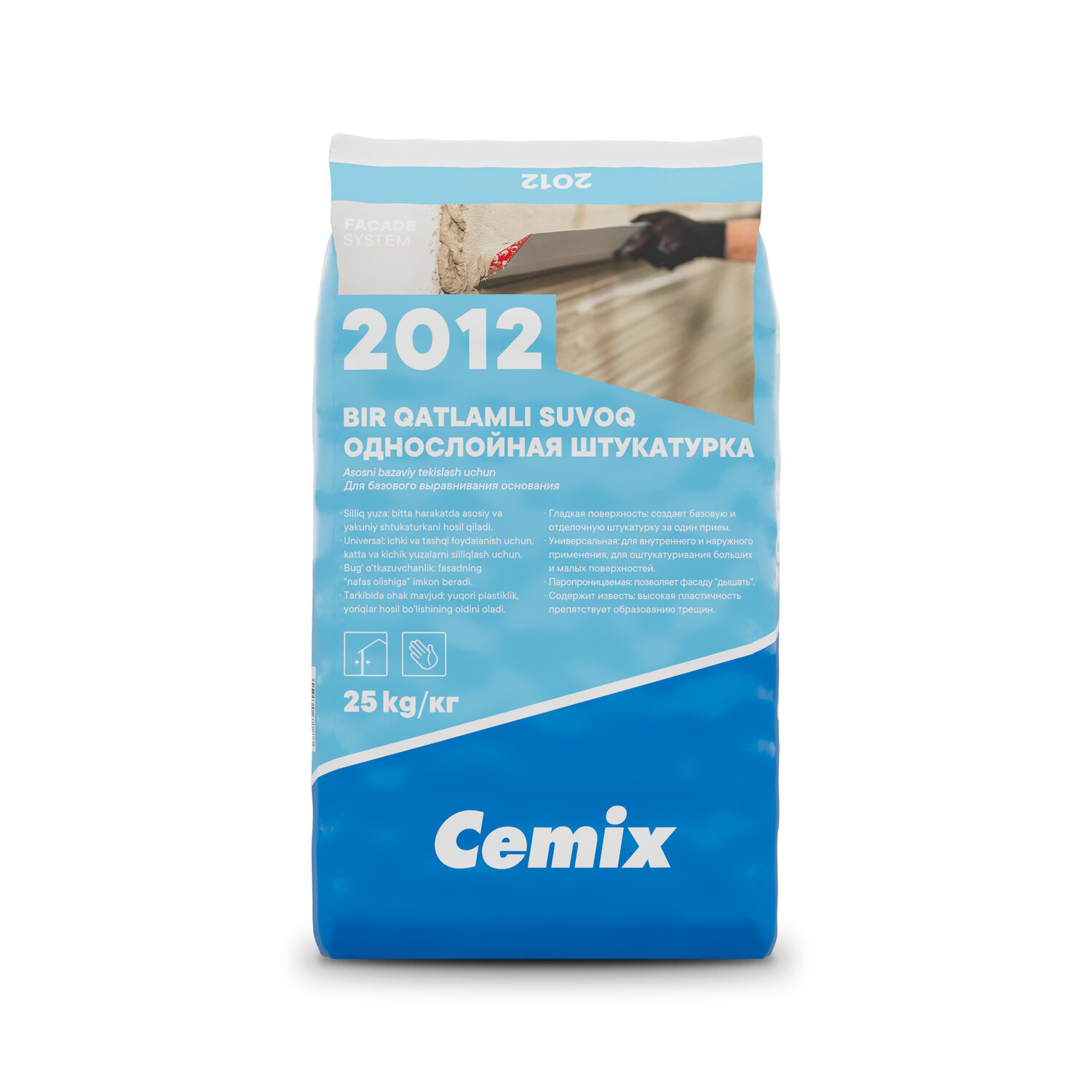


2012
ONE LAYER PLASTER
Perfect single-layer plaster for a smooth, flawless finish
For hand and machine use
- Smooth surface: creates base and top plaster in one step
- Versatile: for plastering large surfaces and small repairs
- Vapour-permeable: for indoors and outdoors
- Contains lime: crack reducing
Area of application
- Outdoors: wall
- Indoor: wall
Processing method
- For hand processing
- For external and internal masonry in new and old residential, public and industrial buildings. It can be applied to dry brick, concrete, aerated concrete, sand-lime brick, natural stone and properly prepared mineral bonded wood wool masonry, protected from salt, water and underground water loads.
Contact

Loading...
Processing details
Learn more about technical details for processing this product.
Substrate requirement
The substrate must comply with the relevant standards, be sound, stable, free from loose particles, dust, dirt, oil, mould release agent residues and efflorescence.
Substrate temperatures between +5°C and +25°C are recommended.
Substrate preparation
Before starting work, cover all surfaces that need to be protected. All masonry defects must be repaired no later than three days before starting work.
Remove any loose or easily crumbling plaster and fill large cracks and chases for pipes with base plaster.
To ensure uniform absorption, stability, and adhesion, the wall substrate must be properly prepared beforehand.
If surface leveling is required, install plastering guides before applying the plaster. The guides must be securely fixed and properly leveled.
Smooth and low-absorbent substrates must be treated with CEMIX 2002 PRE-SPRINKLER. Plaster application can begin after the bonding coat has completely dried.
Absorbent substrates must be treated with CEMIX 2613 PRIMER. The primer must be completely dry before applying the plaster. It is recommended to prepare the substrate at least 1 day before applying the plaster.
Preparation of the mixture
The ONE-COAT PLASTER for manual application is mixed with water directly on the construction site.
Pour 5.0–5.37 liters of water into a clean bucket. Gradually add the dry mix while continuously mixing with a mixer until a homogeneous, lump-free consistency is obtained. After mixing, let the mixture stand for approximately 5 minutes, then remix.
Water demand

| Quantity | Liters (Min) | Liters (Max) |
|---|---|---|
| 25 kg | 5 l | 5.5 l |
| 30 kg | 6 l | 6.45 l |
Mixing
Mixing time
3 min
Processing instructions
The prepared material is applied to the wall using a masonry trowel, leveled with an H-shaped smoothing float, and trimmed with a trapezoidal float.
The recommended layer thickness is 5–20 mm for interior applications and 20–30 mm for exterior applications.
If leveling the substrate requires a layer thicker than 30 mm, the plaster must be applied in several layers. The surface of the previous layer should be treated with a plaster comb to ensure proper adhesion of the subsequent layer.
For substrates with an uneven or heterogeneous structure, it is recommended to use reinforcing fiberglass mesh, which should be embedded into the upper third of the plaster layer.
It is recommended to apply the plaster in a single layer up to 20 mm thick.
Consumption: 1.7 kg/m² per 1 mm of layer thickness. Consumption may vary depending on the evenness of the substrate and application conditions.
Pot life of the prepared mixture: approximately 2 hours.
Application conditions: the temperature of the material, air, and substrate during application should be between +5°C and +35°C.
Tools: masonry trowel, putty knife, H-shaped smoothing float, trapezoidal float, corner trowel.
Shelf life and storage: store in a dry place in unopened packaging for 24 months from the date of manufacture.
Application thickness
| Minimum layer thickness | 5 mm |
|---|---|
| Recommended layer thickness | 15 mm |
| Maximum layer thickness | 30 mm |
Consumption
Material consumption min.
1.75
Material consumption max.
-
Material consumption in measuring unit
Kg/m²/mm
Working time (potlife)

120 min
Treatment after application
Protect the plaster during hardening from premature drying in warm, windy weather by spraying with water. The plastered surface can be covered with tiles, wallpaper, paint, mineral plaster, or smoothing plaster.
Tool and cleaning instructions
Wash off tools with water immediately after finishing work. Clean dried residues mechanically.
Technical parameters
| Main binder | Grey cement |
| Made of material | Cement and lime binders, mineral fillers and property improving additives. |
| Max. grain size | 1mm |
| Dry bulk density in Kg/m³ to | 1182.2 |
Files
|
|