

The two most popular options are cement and anhydrite screeds. Cement screed is versatile and moisture-resistant, while anhydrite screed provides an perfectly smooth surface and sets quickly. The choice depends on the type of room and expected loads to ensure a long-lasting and comfortable floor.
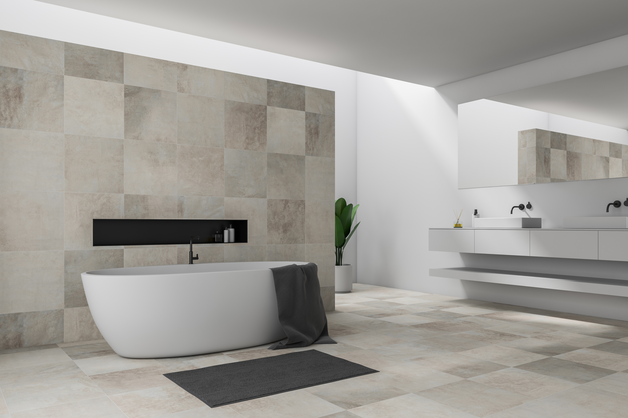
Floor screeds can be cement-based or anhydrite-based (calcium sulfate). Both materials are strong and reliable, but they have different characteristics and areas of application.
Anhydrite screed dries quickly, has minimal shrinkage, and creates a perfectly smooth surface. However, it is not suitable for rooms with constant humidity, as contact with water reduces its strength.
Cement screed requires gradual drying but is safe for damp and poorly ventilated spaces. It is versatile and suitable for most floor types, including kitchens, bathrooms, and basements.
When choosing the material, the primary factor is the room’s usage. For areas with constant moisture, cement remains a reliable solution, while anhydrite is effective in dry rooms and where fast installation and a smooth surface are important.
After laying the screed, it is important to consider the curing time and care methods. Although cement screed contains less water during processing, attention must be paid to the drying rate. Too rapid drying can lead to cracks and deformation. In addition, rapid drying of cement screed at early stages can cause so-called “burning,” where the cement grains hydrate only on the surface or fail to bind fully, preventing the material from fully hardening.
Anhydrite screed, while containing more water, can dry much faster, even with accelerated methods. For example, if underfloor heating is used, it can be turned on after seven days to speed up drying. For cement screed, this period is 28 days. On the other hand, if underfloor heating is not used, anhydrite screed can take a very long time to dry—up to six months in winter.

A major difference between cement and anhydrite screeds lies in the size of the deformation sections (small areas separated by expansion joints). For cement screed, expansion joints should be installed every 3 × 3 meters when underfloor heating is present, and every 6 × 6 meters if there is no underfloor heating.
Anhydrite screed deforms as a whole. To interrupt acoustic bridges, one entire room is considered a single section, and an expansion joint is placed at the doorway. This minimizes sound transmission between rooms and improves acoustic comfort. If the expansion joint is correctly installed, noise transfer is minimal and sound insulation is more effective. However, anhydrite screed can cover areas up to 200 m², so in practice, expansion joints between rooms are often overlooked. Nevertheless, placing an expansion joint at the threshold significantly reduces noise propagation from one room to another.
The second difference between cement and anhydrite screeds is reinforcement.
For cement screed, a reinforcement mesh (welded steel mesh made of ribbed bars) is often used to help compensate for shrinkage at smaller thicknesses and reduce the risk of cracking. In contrast, anhydrite generally does not require reinforcement. If reinforcement is needed, stainless steel mesh should be used to prevent corrosion.
For anhydrite-based mixes, it is also important to avoid contact between anhydrite and aluminum. For example, reflective aluminum foil is sometimes used in underfloor heating systems. It must either have a factory-applied polyethylene coating or be separated from the anhydrite with an additional layer. Otherwise, a chemical reaction occurs between the aluminum and the sulfates in the anhydrite, causing the reflective foil to “melt” and resulting in bubbles and holes on the surface.

