


|
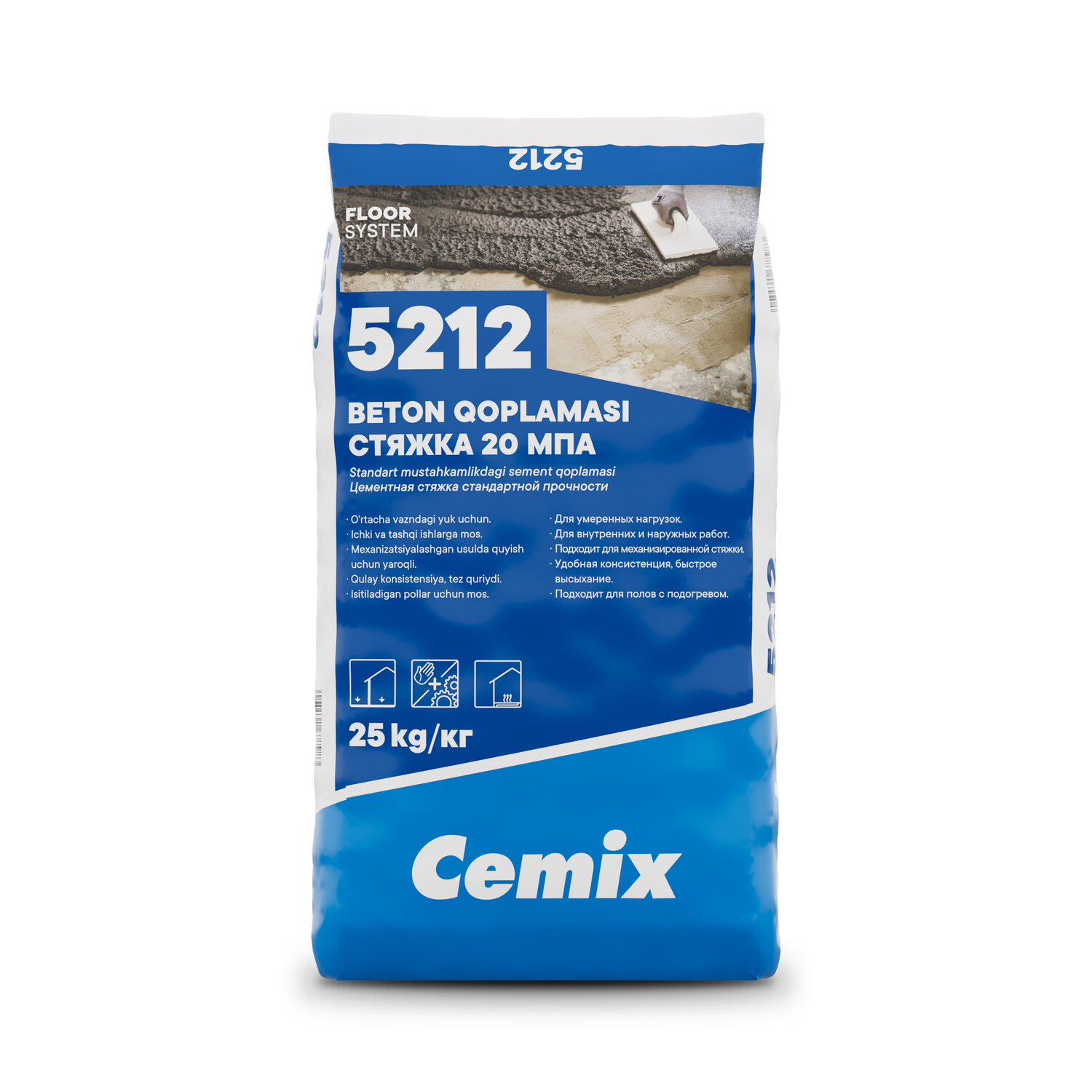


5212
SCREED 20 MPA
Reliable solution for residential building
Indoor and outdoor cement screed for light load surfaces
- Reliable solution: Underlay for low-load paved surfaces. For indoors and outdoors
- Machinable: for quick and efficient work
- Earth moist consistency: no excess water, so dries out faster
- Creates a perfect, flat and strong surface
Area of application
- Outdoor: floor
- Indoor: floor
Heating and cooling area
- Floor
Processing method
- For hand and machine processing
- For indoor and outdoor use. Can be used as a floating screed to prepare the subfloor for the installation of floor coverings or as a contact screed in direct contact with the subfloor. Also suitable for underfloor heating.
RECOMMENDED SYSTEM PRODUCTS
Contact

Loading...
Processing details
Learn more about technical details for processing this product.
Substrate requirement
The substrate must comply with the applicable standards, must be solid, free of loose particles, free of dust, paint, residues of demoulding substances and efflorescence. It must be sufficiently rough, dry and evenly absorbent. The surface shall not be frozen or water-repellent. The substrate must be stable in volume.
Substrate preparation
To create a bonding screed, the weak layer formed on the surface of cement substrates must be removed using mechanical equipment, such as a shot blasting or bead blasting machine. The cement screed should be applied while the bonding bridge is still wet. Pay attention to construction and movement joints, which allow vertical elements of the building, such as walls, columns, and pipes, to expand.
The substrate must comply with applicable regulations, standards, or the manufacturer’s recommendations. It must be solid, free of loose particles, dust, paint, and efflorescence.
For floating or sliding screeds, a separation layer (e.g., 0.2 mm polyethylene film) must be laid across the entire surface before applying the cement screed. If the screed is laid on an insulation layer (floating screed), the separation layer must always be placed between the insulation and the screed. Along vertical walls and around penetrating pipes, an expansion tape with a thickness of at least 5 mm should be installed—at least 8 mm for underfloor heating and 10 mm for outdoor areas. Adjacent surfaces larger than 20 m² should be separated by an expansion profile.
Preparation of the mixture
Pour 25 kg of CEMIX 5212 SCREED 20MPa into 2.25 L of clean water. Mix for 5 minutes using a concrete mixer, horizontal mixer (e.g., PFT HM24), or by hand to a homogeneous mixture without lumps. Leave to rest briefly. Then mix again briefly before use.
Water demand

| Quantity | Liters (Min) | Liters (recommended) |
|---|---|---|
| 25 kg | 2 l | 2,25 l |
Mixing

Mixing time
5 min
Processing instructions
Spread the mass on the prepared substrate and compact it, e.g. with the strokes of a trowel. Then flatten the surface with aluminium H profile lat and smooth it with a plastic or steel trowel. An advantage is the possibility of pulling down with a vibrating lat.
Application thickness
| Minimum layer thickness | 30 mm |
|---|---|
| Maximum layer thickness | 80 mm |
Consumption
Material consumption min.
2
Material consumption max.
-
Material consumption in measuring unit
Kg/m²/mm
Consumption renders
| Activity | Min/Recommend/Max layer thickness | Applied thickness | Min./Max. consumption in kg/m²/mm | Packaging size | Yield |
|---|---|---|---|---|---|
| Lay the screed evenly over the surface | 30mm-100mm | 50mm | 2 kg/m²/mm | 25kg | 0.25 m² |
Working time (potlife)

2 h
Walkability after

1 d
Treatment after application
Avoid the negative effects of sun, heat and draughts. Protect from frost and rain. Direct heating of the surface is prohibited. Keep the screed in a moist condition for 2-3 days.
Technical parameters
| Main binder | Grey cement |
Files
|
|